Publications
Read what we have written about our community, our work and our journey, and what others have written about us.

Do cultural taboos regulate hunting in transitioning Indigenous
communities? The case of the Idu Mishmi of Northeast India
12 Aug 2025
There is rising recognition of resource-use rights of Indigenous Peoples and
Local Communities (IPLCs) within wildlife conservation. Historically, sociocultural
institutions ensured wildlife sustainability in many IPLC areas. However, the
future viability of such institutions is uncertain as IPLCs change in response to external pressures and internal aspirations, potentially rendering many traditional
institutions weak and open to exploitation. This is particularly true for wildlife hunting, which remains a central sociocultural and economic activity for many IPLCs.

Beyond Conflict Vs Coexistence: Human-Tiger relations in Idu Mishmi Land
1 Jun 2019
As you drive into Dibang Valley Arunachal Pradesh, you can't help but be consumed by the scale
and depth of its greenness. It stretches
relentlessly - from its summit of rock and ice
to the glistening depths of the Dibang river beneath. The landscape is at once ominous and hopeful. This formidable greenness hides many secrets. Here, tigers, clouded leopards, and Asiatic wild dogs prowl the mountains, preying on both flesh and spirit. Semi-domesticated gaur (mithun) and Mishmi takin, furrier renditions of
the African wild beast, stand proud atop Mithun, the semi-domesticated gaur, is a precious animal for the Idu Mishmi of Dibang Valley mountain precipices, staring down the clouds. This is the traditional homeland of
the Idu Mishmi people.

Voices from Dibang
notes from a field Assistant
1 Dec 2020
If you’re a scientist or a researcher who has ever
conducted field research, you’ve probably hired one of us – a local field assistant, an insider, a guide, an interlocutor – who is vital in introducing you to local families, the people you call ‘respondents’. We help you collect data, and sometimes, we collect it for you. In return, we are given stipends, honorariums, and occasionally a few additional incentives.
While some lucky ones make it into the ‘Acknowledgments’ of
your reports and publications, most of us are forgotten when
your fieldwork ends. But for us, the story doesn’t end with your departure. Our story continues to include you. Mine is one such story.

First distribution record of the Asiatic Toad Bufo gargarizans Cantor, 1842
from India — Dibang Valley in Arunachal Pradesh
26 Apr 2021
Bufo gargarizans, a species complex, has a wide distribution ranging from Japan to south-western China, Vietnam, and Russia but was not previously reported from India. Surveys conducted in Dibang Valley district of Arunachal Pradesh near the Indo-Tibetan border with China in 2014–15 revealed previously unreported specimens of the toad genus Bufo.

Tribal tigers:
How a shamanic community has saved tigers in the Dibang Valley of Arunachal Pradesh
1 Apr 2019
The prelude:
It was March 2012. I was in the Lower Dibang Valley district of Arunachal Pradesh conducting surveys for a renowned
conservation organisation to determine tiger presence outside Protected Areas of Northeast India. “If you want to find a lot of tigers, you must go high up in the mountains. In our culture, tigers live on tall mountains,” said an Idu Mishmi elder as I sat in his hut close to Roing town, the headquarters of
the Lower Dibang Valley.
The future of conservation lies in listening, not just science
15 Apr 2025
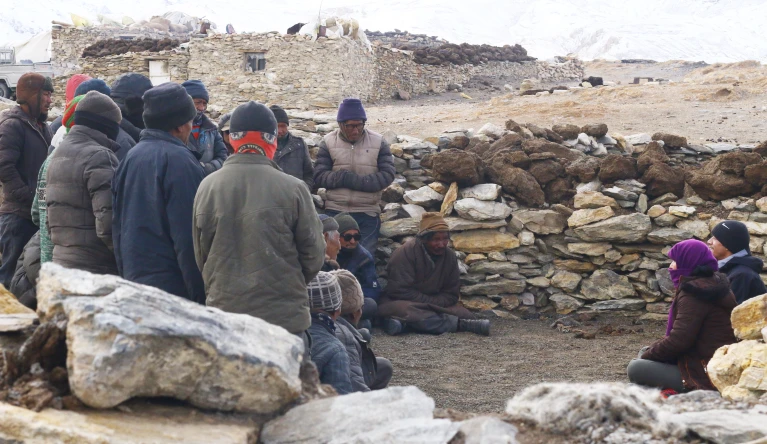
Conservation science follows a top-down model where experts design projects, collect data, and draft policies while Indigenous communities, the stewards of biodiversity, are left out of decision-making. A new global framework challenges this approach and argues that conservation will only succeed if local communities are treated as equal partners in research.

‘Killing with Care’: Locating Ethical Congruence
in Multispecies Political Ecology
7 Apr 2022
Increasing calls to re-conceptualise human relations with nonhuman nature in the Anthropocene have spurred a range of multispecies studies seeking to analytically de-centre the human to focus on the lives and struggles of nonhumans. Scholars have also called for deeper collaborations between conservation biology, political ecology, and critical animal studies. Research spanning these disciplinary approaches has considerable analytical potential but presents seriously discordant ethical positions for interdisciplinary multispecies researchers like us.

Does polymorphism make the
Asiatic golden cat the most adaptable predator in the Eastern Himalayas?
7 Jun 2019
Some wild felines have a diverse range of coat colors; others do not. Jaguars and leopards, for instance, come in spotted and melanistic forms, but tigers are always striped and lions always beige. Smaller cats, like clouded
leopards, marbled cats, and ocelots are almost always patterned in the same way, whereas jaguarundis, oncillas,
and golden cats occur in several different colors and patterns. Does a greater range of coat colors and patterns make some smaller cats more ecologically adaptable
than others? We explore this question for the Asiatic golden cat in light of data from an extensive camera trap study in Northeast India that has revealed a previously
unknown color form and potentially new insights about advantages of polymorphism in this species.

Iho and the Dibang Team
1 Aug 2023
Prelude:
As I finished reading the email invitation from this anthology’s editors to write about my field assistant I flashbacked to the crisp Sunday morning of 3rd February 2014.
“Iho, ela ja!” (come here), gestured Naba Jibi Pulu, my Idu Mishmi godfather.
A young man, tall for an Idu Mishmi, emerged from the bustling, colourful crowd. He wielded a bucket full of ashumbihi
(corn porridge) in one hand and a ladle in another. A bamboo hat
perched precariously on his head. It was the Reh festival in Kebali village located 8 km from Roing, the headquarters of Lower Dibang Valley district of Arunachal Pradesh. A few middle-aged men, merry on yu (homebrewed rice wine), swayed to the tunes of loud Idu pop music. Rows of women and children, messily arranged, sat on thinning grass with leaf platters laid out in front, waiting
impatiently for the feast.
Relations of Blood: Hunting Taboos and Wildlife
Conservation in the Idu Mishmi of Northeast India
1 Jul 2020
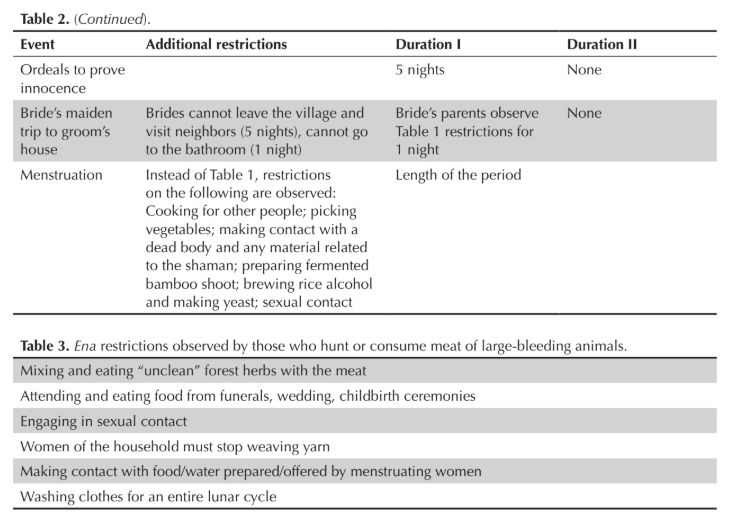
Hunting of wildlife is a significant source of food and cash income, particu-
larly for the rural poor across the tropics (Coad et al. 2019; Milner-Gulland et al.2003). It is also one of the leading causes
of worldwide declines in tropical wildlife (Bennett et al. 2002), even observed in cases where hunting is subsistence only (Chacon 2012; Peres 2000). Yet, for many traditional and Indigenous peoples, hunting and associated rituals are integral to establishing and maintaining social roles, group identities, and reciprocal relations
with nature (Hill 2011; Lewis 2008).

Not ‘all cats are grey in the Dark’
1 Aug 2019
Arunachal’s Dibang Valley The local tales of mountain tigers drew
me to Arunachal Pradesh’s Dibang Valley in
2012. Little did I know that many other stories
were also waiting to unfold. I teamed up with
the local Idu Mishmi and started placing camera
traps across their forests. Twenty months
and more than 200 camera traps later, as
images came in, we found ourselves staring
in amazement at snapshots of medium-sized cats in a striking array of colours. Three sets of cat images confused us in particular: one with spots like those of a leopard, a darker one
with jaguar-like rosette pattern, and, a third
that was pitch black.

Idu Mishmi protect ancestral land through community conservation
28 Feb 2024
https://india.mongabay.com/2024/02/idu-mishmi-protect-ancestral-land-through-community-conservation/
Iho Mitapo grew up hearing stories about how his elders made long journeys every day from their homes in the Elopa and Etugu villages in the hills, crossing forests and encountering herds of wild animals, to reach their farmlands. They cultivated and harvested crops and took the same route back to their homes, said 30-year-old Mitapo who now lives in Roing town of Lower Dibang valley district in Arunachal Pradesh.

Saving Our Land | Indian Activist Defends Against Hydropower | 52 Documentary
3 Aug 2023
Iho Tapo and EECEP’s story: Iho Mitapo is a budding conservationist and adventure travel guide in the remote corner of Northeast India, but hydropower developments could forever change the land he calls home. His tribe, the Idu Mishmi, and the rich biodiversity of Arunachal Pradesh face the looming construction of what will be India’s biggest dam. His community is desperate to preserve the local wildlife on their ancestral lands; can their attempts to create a sanctuary make a difference?
BBC radio show
14 Jul 2023
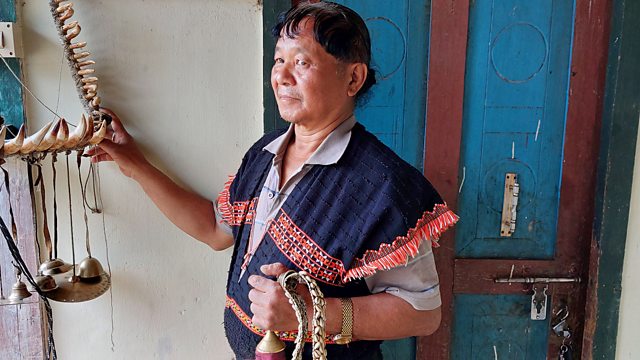
Antonia Bolingbroke-Kent follows Sipa Melo, a shaman in a remote corner of north-east India, as he tries to keep his culture alive in the shadow of the Himalayas.

Protecting Land & Life: Dibang Valley's First Community Conserved Area
30 Jun 2023
Cane fronds brush past my face as I climb up a narrow path. Overhead, the sharp “keeee-keee-kee” of a crested serpent eagle pierces the air. I look up, but the canopy hides my view, allowing only glimpses of blue to filter in. Further up the slope, the familiar sound of a temple bell surprises me. Is there a temple in this area? I listen in wonder as the steady vibration builds to a crescendo. It is, in fact, a tiny, almost invisible denizen of the forest. The bell cicada (Dundubia hastata), often called the bell of the forest, has just announced its presence.
We are in the first Community Conserved Area (CCA) in the Lower Dibang District of Arunachal Pradesh.

New CCA Declared in Dibang Valley
22 Jun 2022
The residents of two villages, Elopa and Etugu, of the Idu Mishmi community in the Lower Dibang valley district of Arunachal Pradesh have declared part of their ancestral customary land as a Community Conserved Area (CCA). The CCA, which measures 65 sq. km., has been named Elopa-Etugu Community Eco-Cultural Preserve (EECEP). The acronym EECEP, when pronounced as a word, makes the sounds that mean ‘a place we have left’ in the Idu Mishmi language. The name itself holds deep meaning for Elopa-Etugu’s clans’ members who were forced to leave their ancestral land in the 1980-90s as the Dibang river (Talõ) changed course, following years of logging, and swallowed their agricultural fields. The following two decades witnessed increased outsider hunting and resource extraction in Elopa-Etugu’s land.
:

Listening Session with the Idu Mishmi
20 Jan 2021
In this Listening Session, the Idu Mishmi share insights into their religion and explore the ways it has enabled them to flourish alongside their fellow species.
The ancestral homeland of the Idu Mishmi community of Northeast India is the rugged and densely forested Dibang Valley, which lies in the Indian state of Arunachal Pradesh in the Eastern Himalayas.